If you've spent any time doing LinkedIn outreach, you already know the frustration. You build a list, craft a message, hit send a hundred times, and wait. Maybe 5 people reply. Maybe 2 are actually interested. And you're left wondering whether the problem is your copy, your targeting, or the tool you're using.
The good news? The problem is almost never your copy. It's your process, and the outdated lead generation tools most people are still relying on.
This article breaks down what modern LinkedIn outreach actually looks like, compares the most popular automation platforms, explains what impressions on LinkedIn really mean for your strategy, and shows you why SendRoq is the smarter play for founders, sales teams, and agencies ready to stop guessing and start closing.
The State of LinkedIn Outreach in 2026
LinkedIn has over 1 billion users, making it the most powerful B2B and B2C sales channel on the planet. Whether you're doing sales outsourcing for clients, running inbound via an affiliate partnership on LinkedIn, or targeting buyers yourself, the platform holds your pipeline. The question is how you unlock it.
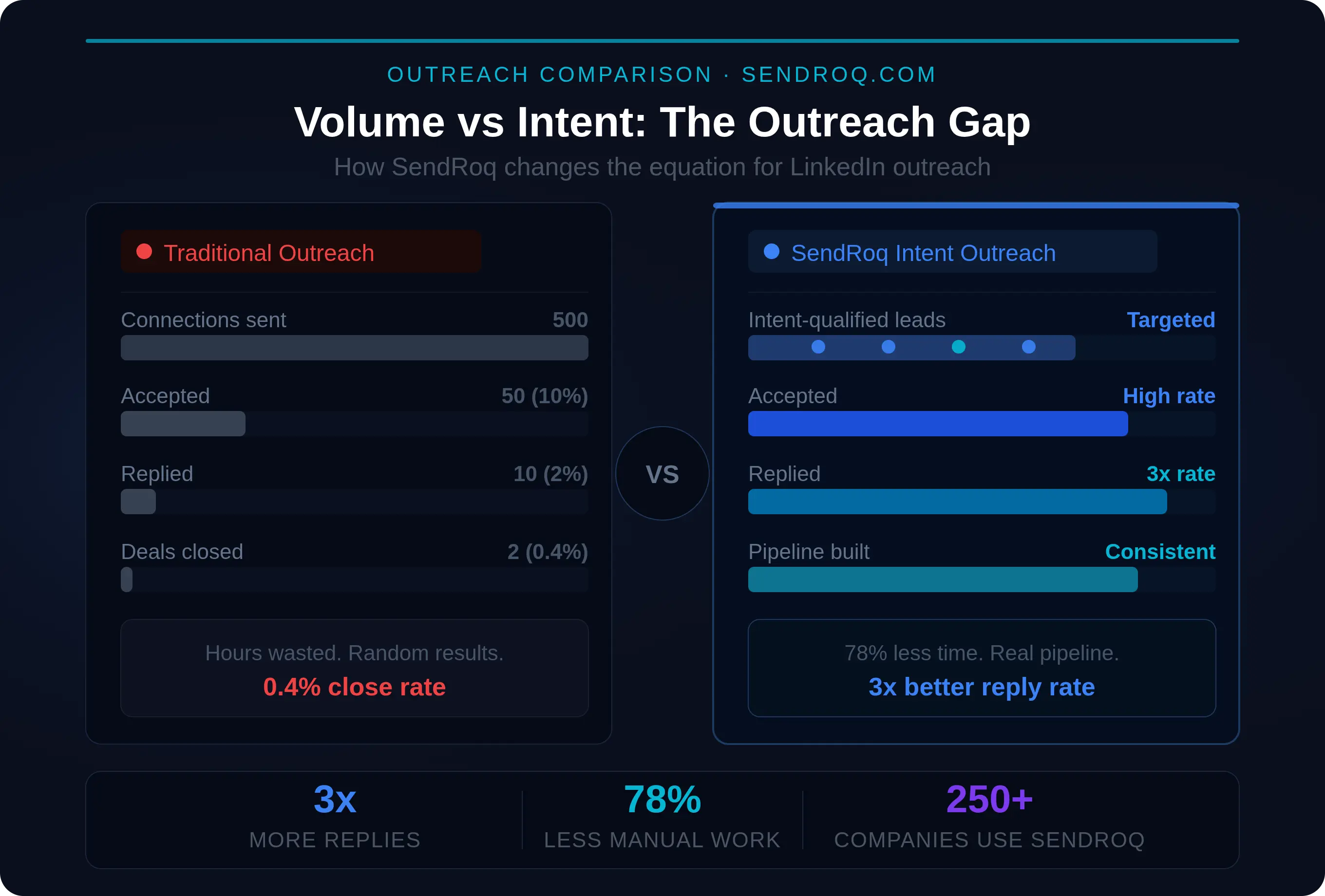
Most people default to volume. Send 500 connection requests, hope 50 accept, and pray 5 reply. That spray-and-pray approach worked in 2019. Today, it gets your account flagged and your messages ignored.
The shift happening right now, across every serious sales team, is from volume-based outreach to intent-based outreach. Instead of reaching out to everyone who matches a job title, the best teams are identifying who is actively showing buying signals right now and reaching out at exactly the right moment.
That's not a philosophy. It's an infrastructure problem. And it's exactly what SendRoq was built to solve.
What Are Impressions on LinkedIn, And Why Do They Matter for Outreach?
Before we get into tools, let's clear up a question that comes up constantly: what are impressions on LinkedIn?
An impression on LinkedIn is recorded every time your post, message, or profile appears on someone's screen, whether they engage with it or not. So what does impressions mean on LinkedIn in practical terms? It means reach. It's how many eyeballs saw your content or your name before they made a decision to engage or scroll past.
What do impressions mean on LinkedIn for your outreach strategy? A lot, actually. If you're running LinkedIn content alongside your outreach sequences, your impression count tells you how much brand awareness you're building in parallel. A prospect who's seen your posts three times before receiving your connection request is far more likely to accept than a cold stranger.
This is why the best outreach strategies combine LinkedIn content (to build impressions) with automated sequences (to close the gap). SendRoq handles the sequence side so you can focus on showing up in feeds.
The Tools Everyone Talks About, Honestly Compared
The LinkedIn automation market is crowded. Here's a clear-eyed look at the most-discussed platforms and where each one falls short for serious outreach teams.
PhantomBuster (Phantom Buster)
PhantomBuster is one of the oldest LinkedIn scraping tools in the market. It's built around "Phantoms", pre-built automations that extract data from LinkedIn profiles, Sales Navigator lists, and groups. It's powerful if you're technical and patient.
The problem with Phantom Buster is that it's fundamentally a data extraction tool, not an outreach engine. You scrape leads, export them to a CSV, import them into another tool, write your own sequences, and manage replies across multiple tabs. The workflow is fragmented, and there's a real risk of LinkedIn account bans if you misconfigure the rate limits. It's a builder's tool, not something you hand to a sales rep and expect results the same week.
RocketReach
RocketReach is a contact enrichment platform, best known for finding verified email addresses and phone numbers. When people compare RocketReach pricing, they're usually looking at it as part of a larger outbound stack, buy the emails here, run the sequences somewhere else.
RocketReach is solid for email-first outreach. But if LinkedIn is your primary channel, you'll hit its limits quickly. It doesn't automate LinkedIn messages, doesn't run sequences, and has no intent signal layer to tell you who's ready to buy right now.
Lemlist
Lemlist is a multichannel outreach platform focused heavily on cold email, with LinkedIn steps added to sequences. It's well-designed, with a strong emphasis on personalization, you can embed custom images and videos into emails, which genuinely lifts reply rates.
Where lemlist struggles is on the LinkedIn-native side. LinkedIn steps in lemlist sequences are manual reminders, not automated actions. You still have to go into LinkedIn and send the message yourself. For teams where LinkedIn is the primary channel rather than a supplement to email, this is a significant gap.
Dripify
Dripify is a cloud-based LinkedIn automation tool with a focus on drip sequences. It runs campaigns from the cloud rather than your browser, which improves account safety compared to browser extension tools. Dripify covers the basics well: connection requests, follow-up messages, profile visits, and endorsements to warm up leads.
The limitation is intelligence. Dripify runs sequences based on time delays and actions, it doesn't know why someone is a good lead right now. It will message someone who showed zero intent the same way it messages someone who just posted about hiring a sales team. That's a volume play, not a precision play.
LinkedIn Helper
LinkedIn Helper is one of the most affordable automation options available, operating as a browser extension with a desktop app component. For solo operators on tight budgets, LinkedIn Helper gets the job done at a low monthly cost.
The tradeoff is risk. Browser-based tools are more detectable by LinkedIn, and the interface shows its age. For founders running their first outreach campaigns, it's a reasonable starting point. For anyone trying to scale across multiple accounts or clients, it creates more problems than it solves.
HeyReach
HeyReach is purpose-built for agencies running LinkedIn outreach across multiple client accounts. It handles multi-account management, rotating senders, and team inboxes cleanly. If you're managing outreach for 10+ clients simultaneously, HeyReach has infrastructure that smaller tools don't.
The gap is on the intelligence layer. HeyReach automates the sending but relies on you to build the targeting. You still need to export leads from Sales Navigator, define your sequences manually, and figure out who to reach out to. The automation is there; the intent data is not.
Expandi
Expandi is a cloud-based LinkedIn automation tool that's been around long enough to build a solid reputation for account safety. It uses randomized delays and working-hour logic to make automation look human. Expandi also supports a webhook-based integration with tools like Zapier, making it relatively flexible for technical teams.
Like most tools in this category, though, Expandi's core model is sequence-first, data-second. You bring the leads; it sends the messages. The heavy lifting of identifying who to reach out to, and when, still falls on you.
LinkedIn Sales Navigator Account Targeting Features, And Their Limits
Many sales teams rely on LinkedIn Sales Navigator account targeting features to build their lead lists. Sales Navigator is genuinely powerful, you can filter by company size, industry, growth signals, job postings, and more. The account targeting features let you build lists of companies and then find decision-makers within them.
But here's the catch: Sales Navigator tells you who fits your ICP, it doesn't tell you who is ready to buy. A company that matches every filter on your list might be in a budget freeze, or just signed a competitor, or be months away from the kind of initiative you solve. You end up spending time on perfectly-profiled leads who have zero intent.
This is the gap that SendRoq's Intent Radar closes. Rather than just filtering by firmographic data, SendRoq scans for active buying signals, job postings, profile activity, engagement patterns, and surfaces leads who are showing intent right now. You still get the ICP match. You also get the timing intelligence that Sales Navigator doesn't provide.
What Is B2C Sales, And Does LinkedIn Work for It?
A question that comes up often in discussions about LinkedIn outreach: what is B2C sales, and does LinkedIn really apply to it?
B2C sales (business-to-consumer) means selling directly to individual consumers rather than to other businesses. Traditionally, LinkedIn has been thought of as a B2B channel. But in 2026, that line has blurred significantly. Coaches, consultants, creators, and service providers are consistently finding their best individual clients through LinkedIn, not through Instagram or Facebook ads.
The difference is intent. A person who is on LinkedIn is in a professional mindset. They're thinking about their career, their business, their goals. A coach offering leadership development, a financial advisor targeting high-earning professionals, or a recruiter sourcing candidates, all of these are B2C use cases that work well on LinkedIn with the right outreach approach.
SendRoq is already trusted by 250+ B2B and B2C startups. The platform's intent signals work equally well for both because the underlying behavior, someone actively engaging with professional content, updating their profile, hiring for a role, signals readiness regardless of whether you're selling to them as a business or an individual.
The AI Sales Tools Shift: Why Best AI Agents Are Replacing Manual Prospecting
The broader category that LinkedIn automation fits into is AI sales tools, software that uses artificial intelligence to handle tasks that used to require a human sales rep. Lead research, message personalization, sequence optimization, reply detection, all of this is now being handled by the best AI agents on the market.
What separates the best AI agents from basic automation is the degree to which they can make decisions, not just execute instructions. A basic tool sends your pre-written message to a list you built. An AI agent figures out who should be on the list, writes the message based on that person's profile and activity, sends it at the right time, and flags responses that need your attention.
SendRoq is built in this model. You tell it your ideal customer profile, job title, industry, company size. The Intent Radar handles the rest: scanning LinkedIn for matching profiles showing active buying signals, scoring each lead before it reaches you, generating personalized connection requests and follow-up messages in your voice, and routing all replies into a unified inbox.
The result is what their customers consistently report: 3x more replies than cold outreach, 78% less time spent on manual prospecting, and campaigns that run 24/7 without anyone babysitting a browser tab.
Pricing That Actually Makes Sense
One of the biggest complaints about enterprise outreach tools is pricing opacity. You have to book a demo to find out what anything costs. SendRoq takes the opposite approach.
Plans start at $59/month for the Solo tier, one LinkedIn account, Intent Radar included, automated sequences, AI-personalized messages, and a unified inbox. The Team plan at $119/month covers three LinkedIn accounts with campaign analytics and priority support. The Business plan at $249/month is built for agencies, with 10 LinkedIn accounts, a client management dashboard, and white-label capability.
No hidden fees. No annual contracts you can't escape. No SDR salary required.
The Bottom Line
The LinkedIn automation landscape in 2026 is mature, crowded, and largely commoditized at the sequence level. PhantomBuster, Dripify, LinkedIn Helper, HeyReach, Expandi, and lemlist all do variations of the same thing: they automate the sending of messages to lists you build yourself.
The differentiation that actually moves the needle is intelligence — knowing who to reach out to, and when, based on real signals of intent. That's what SendRoq brings that the rest of the stack doesn't.
If you're done sending 500 messages hoping 3 people reply, and you're ready to start with the 3 who are already interested, SendRoq is the place to start.
SendRoq is an AI-powered LinkedIn outreach platform trusted by 250+ B2B and B2C startups. Plans start at $59/month with no contracts.
If you've spent any time doing LinkedIn outreach, you already know the frustration. You build a list, craft a message, hit send a hundred times, and wait. Maybe 5 people reply. Maybe 2 are actually interested. And you're left wondering whether the problem is your copy, your targeting, or the tool you're using.
The good news? The problem is almost never your copy. It's your process, and the outdated lead generation tools most people are still relying on.
This article breaks down what modern LinkedIn outreach actually looks like, compares the most popular automation platforms, explains what impressions on LinkedIn really mean for your strategy, and shows you why SendRoq is the smarter play for founders, sales teams, and agencies ready to stop guessing and start closing.
The State of LinkedIn Outreach in 2026
LinkedIn has over 1 billion users, making it the most powerful B2B and B2C sales channel on the planet. Whether you're doing sales outsourcing for clients, running inbound via an affiliate partnership on LinkedIn, or targeting buyers yourself, the platform holds your pipeline. The question is how you unlock it.
Most people default to volume. Send 500 connection requests, hope 50 accept, and pray 5 reply. That spray-and-pray approach worked in 2019. Today, it gets your account flagged and your messages ignored.
The shift happening right now, across every serious sales team, is from volume-based outreach to intent-based outreach. Instead of reaching out to everyone who matches a job title, the best teams are identifying who is actively showing buying signals right now and reaching out at exactly the right moment.
That's not a philosophy. It's an infrastructure problem. And it's exactly what SendRoq was built to solve.
What Are Impressions on LinkedIn, And Why Do They Matter for Outreach?
Before we get into tools, let's clear up a question that comes up constantly: what are impressions on LinkedIn?
An impression on LinkedIn is recorded every time your post, message, or profile appears on someone's screen, whether they engage with it or not. So what does impressions mean on LinkedIn in practical terms? It means reach. It's how many eyeballs saw your content or your name before they made a decision to engage or scroll past.
What do impressions mean on LinkedIn for your outreach strategy? A lot, actually. If you're running LinkedIn content alongside your outreach sequences, your impression count tells you how much brand awareness you're building in parallel. A prospect who's seen your posts three times before receiving your connection request is far more likely to accept than a cold stranger.
This is why the best outreach strategies combine LinkedIn content (to build impressions) with automated sequences (to close the gap). SendRoq handles the sequence side so you can focus on showing up in feeds.
The Tools Everyone Talks About, Honestly Compared
The LinkedIn automation market is crowded. Here's a clear-eyed look at the most-discussed platforms and where each one falls short for serious outreach teams.
PhantomBuster (Phantom Buster)
PhantomBuster is one of the oldest LinkedIn scraping tools in the market. It's built around "Phantoms", pre-built automations that extract data from LinkedIn profiles, Sales Navigator lists, and groups. It's powerful if you're technical and patient.
The problem with Phantom Buster is that it's fundamentally a data extraction tool, not an outreach engine. You scrape leads, export them to a CSV, import them into another tool, write your own sequences, and manage replies across multiple tabs. The workflow is fragmented, and there's a real risk of LinkedIn account bans if you misconfigure the rate limits. It's a builder's tool, not something you hand to a sales rep and expect results the same week.
RocketReach
RocketReach is a contact enrichment platform, best known for finding verified email addresses and phone numbers. When people compare RocketReach pricing, they're usually looking at it as part of a larger outbound stack, buy the emails here, run the sequences somewhere else.
RocketReach is solid for email-first outreach. But if LinkedIn is your primary channel, you'll hit its limits quickly. It doesn't automate LinkedIn messages, doesn't run sequences, and has no intent signal layer to tell you who's ready to buy right now.
Lemlist
Lemlist is a multichannel outreach platform focused heavily on cold email, with LinkedIn steps added to sequences. It's well-designed, with a strong emphasis on personalization, you can embed custom images and videos into emails, which genuinely lifts reply rates.
Where lemlist struggles is on the LinkedIn-native side. LinkedIn steps in lemlist sequences are manual reminders, not automated actions. You still have to go into LinkedIn and send the message yourself. For teams where LinkedIn is the primary channel rather than a supplement to email, this is a significant gap.
Dripify
Dripify is a cloud-based LinkedIn automation tool with a focus on drip sequences. It runs campaigns from the cloud rather than your browser, which improves account safety compared to browser extension tools. Dripify covers the basics well: connection requests, follow-up messages, profile visits, and endorsements to warm up leads.
The limitation is intelligence. Dripify runs sequences based on time delays and actions, it doesn't know why someone is a good lead right now. It will message someone who showed zero intent the same way it messages someone who just posted about hiring a sales team. That's a volume play, not a precision play.
LinkedIn Helper
LinkedIn Helper is one of the most affordable automation options available, operating as a browser extension with a desktop app component. For solo operators on tight budgets, LinkedIn Helper gets the job done at a low monthly cost.
The tradeoff is risk. Browser-based tools are more detectable by LinkedIn, and the interface shows its age. For founders running their first outreach campaigns, it's a reasonable starting point. For anyone trying to scale across multiple accounts or clients, it creates more problems than it solves.
HeyReach
HeyReach is purpose-built for agencies running LinkedIn outreach across multiple client accounts. It handles multi-account management, rotating senders, and team inboxes cleanly. If you're managing outreach for 10+ clients simultaneously, HeyReach has infrastructure that smaller tools don't.
The gap is on the intelligence layer. HeyReach automates the sending but relies on you to build the targeting. You still need to export leads from Sales Navigator, define your sequences manually, and figure out who to reach out to. The automation is there; the intent data is not.
Expandi
Expandi is a cloud-based LinkedIn automation tool that's been around long enough to build a solid reputation for account safety. It uses randomized delays and working-hour logic to make automation look human. Expandi also supports a webhook-based integration with tools like Zapier, making it relatively flexible for technical teams.
Like most tools in this category, though, Expandi's core model is sequence-first, data-second. You bring the leads; it sends the messages. The heavy lifting of identifying who to reach out to, and when, still falls on you.
LinkedIn Sales Navigator Account Targeting Features, And Their Limits
Many sales teams rely on LinkedIn Sales Navigator account targeting features to build their lead lists. Sales Navigator is genuinely powerful, you can filter by company size, industry, growth signals, job postings, and more. The account targeting features let you build lists of companies and then find decision-makers within them.
But here's the catch: Sales Navigator tells you who fits your ICP, it doesn't tell you who is ready to buy. A company that matches every filter on your list might be in a budget freeze, or just signed a competitor, or be months away from the kind of initiative you solve. You end up spending time on perfectly-profiled leads who have zero intent.
This is the gap that SendRoq's Intent Radar closes. Rather than just filtering by firmographic data, SendRoq scans for active buying signals, job postings, profile activity, engagement patterns, and surfaces leads who are showing intent right now. You still get the ICP match. You also get the timing intelligence that Sales Navigator doesn't provide.
What Is B2C Sales, And Does LinkedIn Work for It?
A question that comes up often in discussions about LinkedIn outreach: what is B2C sales, and does LinkedIn really apply to it?
B2C sales (business-to-consumer) means selling directly to individual consumers rather than to other businesses. Traditionally, LinkedIn has been thought of as a B2B channel. But in 2026, that line has blurred significantly. Coaches, consultants, creators, and service providers are consistently finding their best individual clients through LinkedIn, not through Instagram or Facebook ads.
The difference is intent. A person who is on LinkedIn is in a professional mindset. They're thinking about their career, their business, their goals. A coach offering leadership development, a financial advisor targeting high-earning professionals, or a recruiter sourcing candidates, all of these are B2C use cases that work well on LinkedIn with the right outreach approach.
SendRoq is already trusted by 250+ B2B and B2C startups. The platform's intent signals work equally well for both because the underlying behavior, someone actively engaging with professional content, updating their profile, hiring for a role, signals readiness regardless of whether you're selling to them as a business or an individual.
The AI Sales Tools Shift: Why Best AI Agents Are Replacing Manual Prospecting
The broader category that LinkedIn automation fits into is AI sales tools, software that uses artificial intelligence to handle tasks that used to require a human sales rep. Lead research, message personalization, sequence optimization, reply detection, all of this is now being handled by the best AI agents on the market.
What separates the best AI agents from basic automation is the degree to which they can make decisions, not just execute instructions. A basic tool sends your pre-written message to a list you built. An AI agent figures out who should be on the list, writes the message based on that person's profile and activity, sends it at the right time, and flags responses that need your attention.
SendRoq is built in this model. You tell it your ideal customer profile, job title, industry, company size. The Intent Radar handles the rest: scanning LinkedIn for matching profiles showing active buying signals, scoring each lead before it reaches you, generating personalized connection requests and follow-up messages in your voice, and routing all replies into a unified inbox.
The result is what their customers consistently report: 3x more replies than cold outreach, 78% less time spent on manual prospecting, and campaigns that run 24/7 without anyone babysitting a browser tab.
Pricing That Actually Makes Sense
One of the biggest complaints about enterprise outreach tools is pricing opacity. You have to book a demo to find out what anything costs. SendRoq takes the opposite approach.
Plans start at $59/month for the Solo tier, one LinkedIn account, Intent Radar included, automated sequences, AI-personalized messages, and a unified inbox. The Team plan at $119/month covers three LinkedIn accounts with campaign analytics and priority support. The Business plan at $249/month is built for agencies, with 10 LinkedIn accounts, a client management dashboard, and white-label capability.
No hidden fees. No annual contracts you can't escape. No SDR salary required.
The Bottom Line
The LinkedIn automation landscape in 2026 is mature, crowded, and largely commoditized at the sequence level. PhantomBuster, Dripify, LinkedIn Helper, HeyReach, Expandi, and lemlist all do variations of the same thing: they automate the sending of messages to lists you build yourself.
The differentiation that actually moves the needle is intelligence — knowing who to reach out to, and when, based on real signals of intent. That's what SendRoq brings that the rest of the stack doesn't.
If you're done sending 500 messages hoping 3 people reply, and you're ready to start with the 3 who are already interested, SendRoq is the place to start.
SendRoq is an AI-powered LinkedIn outreach platform trusted by 250+ B2B and B2C startups. Plans start at $59/month with no contracts.